

Teams that take an MVP-first approach to building their product typically reach the market up to 50% faster and cut early-stage development costs by as much as 60%, compared with building a full-featured product from day one. That’s the pitch every founder hears. What rarely gets said out loud is that none of those numbers hold up if the team building your MVP doesn’t understand what an MVP is for.
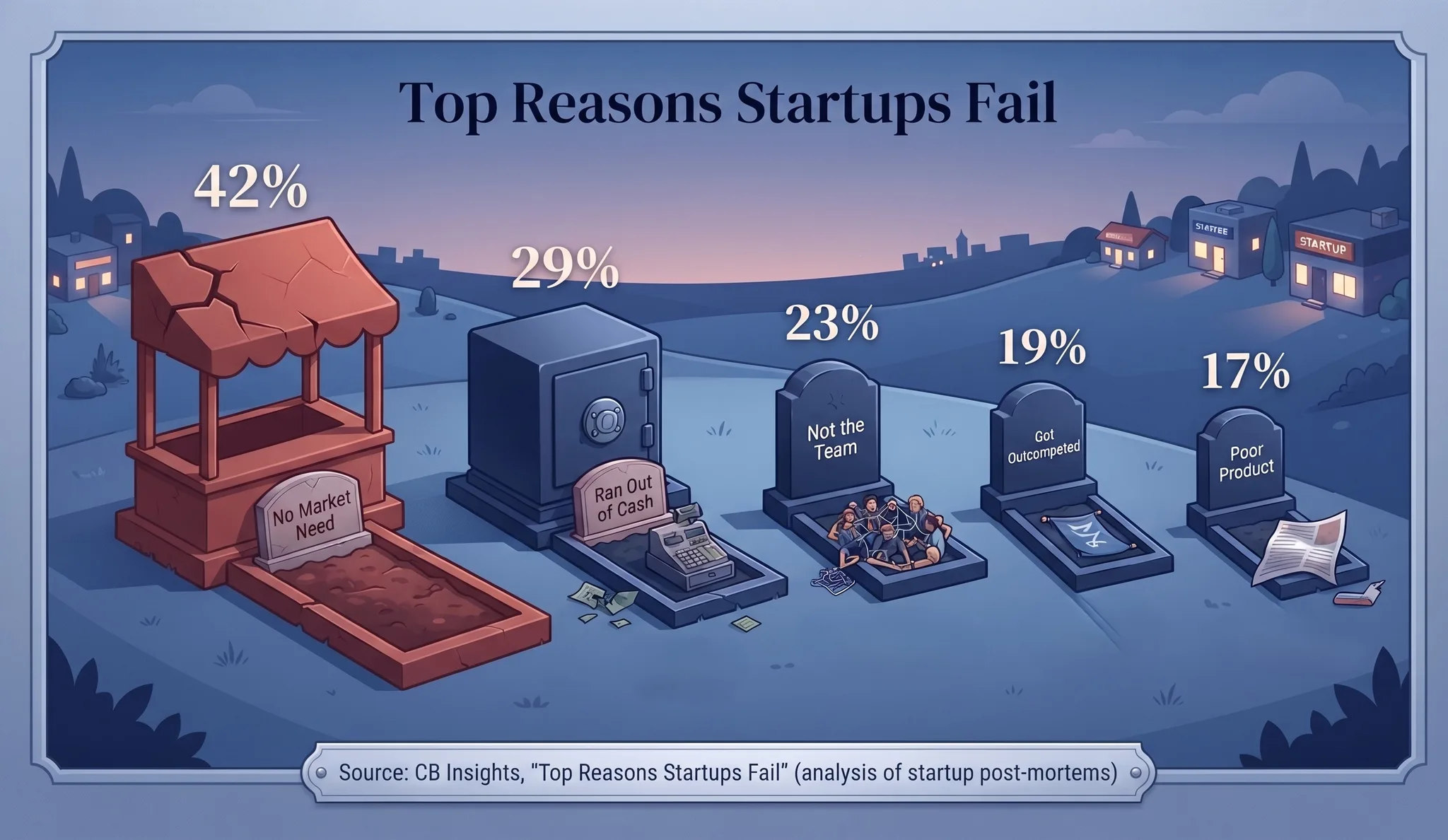
The stakes behind that choice are higher than they look. According to CB Insights’ widely cited analysis of startup post-mortems, “no market need” remains the single most common reason startups fail, cited in roughly 42% of cases studied, well ahead of running out of cash or having the wrong team. An MVP exists specifically to catch that problem early, before your budget and runway are gone. Choosing the wrong development partner doesn’t just risk a messy build; it risks the very validation the MVP was supposed to deliver.
So how do you separate a genuine MVP development partner from an agency that will simply take your brief, build whatever you ask for, and hand you a bill? Here are the factors that actually matter.
1. Make Sure They Understand What an MVP Really Is
This sounds obvious, but it’s the fastest way to filter out the wrong partners. An MVP is not a smaller, cheaper version of your final product. It’s the leanest version that still solves a real problem for real users, built specifically so you can learn from it. A partner who understands this will ask about your target users, the core problem you’re solving, and how you plan to measure success before they ask about frameworks or sprint counts. Watch for the opposite signal too: if an agency starts talking about “full feature sets” and “future proofing” in the very first conversation, that’s usually a sign they’re optimizing for a bigger invoice, not a faster validation cycle.
2. Ask for Relevant MVP Experience, Not Just a Portfolio
A long portfolio is reassuring, but it isn’t the same as relevant experience. What you want to know is how many MVPs the team has shipped in the last couple of years, what happened to those products afterward, and whether they’ve worked in or near your industry before. A partner who can walk you through a handful of specific, comparable projects including ones that didn’t go perfectly is more valuable than one who can only show polished case studies.
Client references matter here more than star ratings on a directory site. A quick call with a past client, focused on reliability, communication, and how the team handled setbacks, tells you far more than any portfolio page.
3. Prioritize Communication and a Visible, Agile Process

MVP development lives or dies on iteration. That means you want a partner who works in short, visible sprints with regular check-ins, rather than one who disappears for weeks and reappears with a finished build you didn’t get to steer. Ask what a typical week of collaboration looks like:
Who is your point of contact? How often do you see progress?
How are changes in scope handled once development is underway?
Agencies that lean on prioritization frameworks such as MoSCoW (Must have, should have, could have, Won’t have) or RICE (Reach, Impact, Confidence, Effort) tend to keep MVP scope disciplined, which matters when it’s tempting to add “just one more feature” before launch.
4. Check Their Technical Depth, in Specifics
Buzzwords are cheap; specifics aren’t. A capable MVP partner should be able to explain, in plain language, why they’d choose a particular tech stack for your product, how they approach scalability from day one, and how they handle security and data protection even at the MVP stage. Cloud-native and modular architectures have become the baseline expectation, since they make it far easier to scale the product later without a costly rebuild.
It’s also worth asking directly how user-centered design fits into their process. A good partner treats usability as part of the default build, not an optional extra bolted at the end.
5. Get Clarity on Pricing and Timelines Upfront
Costs for professional MVP development vary widely depending on scope and platform, but as a general market reference, custom-built MVPs from experienced teams commonly range from roughly $15,000 – $50,000, with mobile apps typically costing more than web apps. No-code MVPs built on tools like Bubble or FlutterFlow can come in lower, often in the $5,000 – $15,000 range, though they trade off some flexibility for speed.
The number itself matters less than how confidently a partner can explain it. Vague timelines, pricing that keeps shifting after the scoping call, or reluctance to put deliverables in writing are all signs to slow down. As several founders who’ve been burned put it, the cost of choosing the wrong partner isn’t just the invoice; it’s the months of runway and market timing you don’t get back.
6. Protect Your IP and Get Everything in Writing
Before any code gets written, make sure the contract clearly assigns intellectual property to you, includes a signed NDA if you’re sharing sensitive details, and spells out service-level expectations. At project handoff, you should receive clean, documented code and architecture notes your internal team (or your next vendor) can pick up and understand, rather than a black box that only the original developers can maintain.
7. Ask About Life After Launch

Shipping the MVP is the beginning of the relationship, not the end of it. Ask what the plan looks like for the first 90 days after launch:
How are bugs handled?
How is user feedback captured and fed back into the roadmap?
Is there a clear path from MVP to the next funded phase of the product?
The strongest MVP partnerships tend to evolve from “build my product” into an ongoing technical advisory relationship, and that only happens if the post-launch plan was clear from the very first conversation.
8. Weigh Cultural Fit Alongside Capability
Technical skill gets a partner shortlisted; cultural fit is often what determines whether the collaboration works. Do their working hours and communication style match how your team operates? Do they push back constructively when they disagree with a request, or simply say yes to everything? A partner who is comfortable being candid about risk and trade-offs, rather than one who avoids difficult conversations, will generally serve your startup better over the life of the product.
Bringing It Together
Finding the right MVP development partner isn’t about hiring the biggest name or the cheapest quote, it’s about finding a team that treats your MVP as a learning tool, communicates transparently, and sticks around long enough to help you act on what you learn. Run through the checklist above during your scoping calls, ask the uncomfortable questions early, and pay close attention to how a potential partner responds to them. That conversation alone will tell you most of what you need to know.
At Digiratina, this is exactly the approach we bring to every MVP engagement: understanding the problem before the tech stack, building in transparent, iterative sprints, and staying involved well past launch day. If you’re evaluating MVP development partners for your next product, we’re happy to be one of the conversations on your shortlist. Contact us today!